Why Dads of Autistic Children Need Community Too
Dads of autistic children need community because parenting can feel isolating, emotionally demanding, and difficult to navigate alone. Supportive father-focused spaces give dads a place to share resources, ask questions, reduce burnout, and connect with others who understand the experience of raising an autistic child.
Parenting an autistic child can come with beautiful moments, deep learning, and meaningful connection. It can also come with stress, uncertainty, appointments, advocacy, safety concerns, school meetings, and the quiet pressure of trying to figure everything out.
For many families, mothers are often the ones seen joining parent groups, attending meetings, asking questions online, or seeking emotional support. But dads need support too.
In a conversation with Dr. Jonathan Chism, founder of the Autism Dad Social Club, one message came through clearly: fathers benefit from connection, and families are stronger when dads have community.

Connection and community can reduce isolation for fathers raising autistic children.
Why Dads Can Feel Isolated
Many fathers are deeply involved in their child’s life, but they may not always have a place to process what they are experiencing.
Some dads feel pressure to stay strong, provide financially, solve problems, or hold things together emotionally. Others may not know where to go for support, especially if most parent spaces are not designed with fathers in mind.
This can lead to dads quietly carrying stress without naming it.
They may be wondering:
How do I support my child’s needs?
How do I help my family without burning out?
Who can I talk to who understands this?
Am I the only dad feeling this way?
The answer is no. They are not alone.
Community Helps Dads Feel Understood
One of the most powerful parts of community is being around people who understand without needing a long explanation.
For parents of autistic children, this can be incredibly meaningful. In everyday settings, families may feel watched, judged, questioned, or misunderstood. A child may communicate differently, move differently, need sensory support, elope, have strong preferences, or become overwhelmed in public spaces.
In an understanding community, families do not have to explain every moment.
Dads can talk honestly about school meetings, therapy decisions, behavior concerns, safety worries, communication differences, and family routines. They can ask questions without feeling embarrassed. They can learn from fathers who are further along in the journey.
That kind of connection can soften isolation.

Support can happen through simple moments of connection and understanding.
Support Groups Do Not Have to Feel Heavy
One important point Dr. Chism shared is that the Autism Dad Social Club is not designed to feel like a gloomy support group. Support matters, but connection can also happen through fun.
Dads may meet for bowling, food, pool, a driving range, or another relaxed activity. The goal is not to sit in a circle and only talk about challenges. The goal is to create a space where fathers can recharge, socialize, laugh, ask questions, and build relationships.
That matters because parents need respite too.
Respite does not always mean a long vacation or a major break. Sometimes respite is two hours with other dads who understand your life. Sometimes it is eating wings, shooting pool, and realizing you are not the only one navigating this path.
Why Father-Focused Support Matters
Family support often centers around the child, which is understandable. Children need services, advocacy, and care. But parents are part of the child’s support system.
When dads feel connected, supported, and informed, that can positively affect the whole family.
Father-focused support can help dads:
Feel less isolated
Share practical resources
Learn from experienced parents
Talk about emotional stress
Build confidence in advocacy
Create friendships for themselves and their children
Reduce caregiver burnout
This is not about separating dads from the rest of the family. It is about making sure dads have a place to belong too.
Dads Can Share Practical Resources
Community is not only emotional. It is practical.
In Dr. Chism’s group, dads use tools like WhatsApp to share resources, ask questions, and support each other between meetups. A dad might ask about tracking devices for elopement concerns. Another might ask about IEP advocacy. Someone else may know a therapist, school resource, event, or strategy that helped their family.
These small exchanges can make a big difference.
When families are navigating autism services, they often have to learn systems that feel complicated: therapy options, school supports, insurance, safety tools, community programs, and local resources.
A parent who has already walked through part of that maze can help another parent avoid feeling lost.
Community Can Support Autistic Children Too
The benefit of parent community does not stop with the adults.
When families gather in accepting spaces, autistic children also get opportunities to connect, participate, and be themselves. Family events can create environments where children are understood rather than judged.
That does not mean every child will engage in the same way. Some may play with others. Some may stay close to a parent. Some may move around, stim, explore, observe, or need breaks.
The point is not to force social behavior. The point is to create opportunities for belonging.
A neurodiversity-affirming community makes room for different ways of participating.
The Village Still Matters
Many families have heard the phrase that it takes a village to raise a child. But in modern life, that village can be hard to find.
Families may live far from relatives. Schedules may be packed. Parents may feel disconnected from neighbors or community spaces. Social media can create the illusion of connection while still leaving people feeling alone.
For families of autistic children, a supportive village can be especially important.
A strong village might include:
Family members
Therapists
Teachers
Support coordinators
Parent friends
Other autistic individuals
Community groups
Faith or cultural communities
Local recreation programs
Online support spaces
No one person has to be the entire village. The goal is to build a wider circle of support over time.
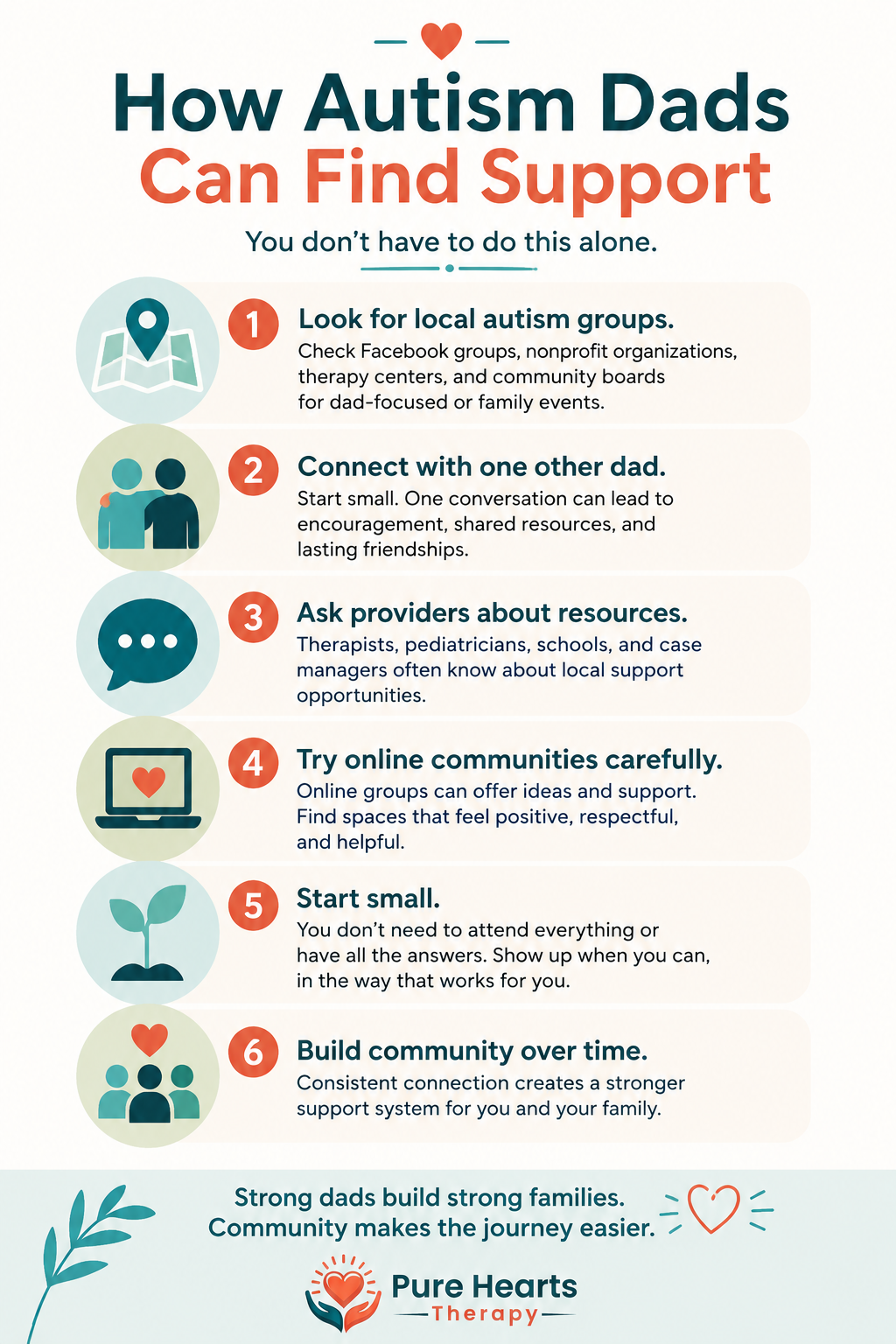
Small steps toward connection can make a meaningful difference.
What Dads Can Do If They Feel Alone
If you are a dad of an autistic child and you do not currently have community, you do not need to solve everything at once.
Start small.
Look for Local Autism Organizations
Search for local autism organizations, parent groups, recreation programs, or family events in your area. Autism Society chapters, local nonprofits, therapy clinics, and community centers may offer events or groups.
Try Online Groups Carefully
Online groups can be helpful, especially when local options are limited. Look for spaces that feel respectful, supportive, and aligned with your values. Not every group will be the right fit, and that is okay.
Connect With One Other Dad
Community does not need to start with twenty people. It can begin with one conversation. If you know another father raising an autistic child, consider inviting him to coffee, lunch, or a low-pressure activity.
Ask Providers About Parent Resources
Therapists, teachers, support coordinators, and pediatric providers may know about local parent groups or events. You can ask, “Are there any father-focused or family support groups you recommend?”
Consider Starting Something Simple
If you cannot find a group, you might start one. That does not mean creating a formal nonprofit or planning a giant event. It could begin with three dads meeting once a month.
Simple is allowed.
What Makes a Supportive Autism Dad Group Work?
A helpful dad group does not have to be complicated, but it should feel safe and welcoming.
Strong groups often include:
Consistent meeting times
Low-pressure activities
Respect for different parenting experiences
Acceptance of autistic children
Space for practical resource sharing
No judgment around support needs
A balance of fun and honest conversation
The best communities do not require families to perform or pretend. They create space for real life.
How This Connects to Caregiver Wellness
Caregiver wellness is not selfish. It is part of sustainable family life.
Parents who feel supported are often better able to advocate, stay regulated, make thoughtful decisions, and show up for their children with more patience. This does not mean parents need to be perfect or calm all the time. It means they deserve support too.
For dads, community can be a protective factor against burnout. It can also offer a place to talk about things that may be hard to discuss elsewhere.
If you are noticing stress, exhaustion, irritability, loneliness, or emotional shutdown, those are signs that support may be needed. You do not have to wait until you are overwhelmed to seek connection.
A Neurodiversity-Affirming View of Parent Support
Supporting parents should never be about “fixing” autistic children. A neurodiversity-affirming approach recognizes that autistic children deserve respect, connection, and support that honors who they are.
Parent communities are most helpful when they move away from fear-based language and toward understanding.
That means asking questions like:
How can we better understand our child’s needs?
What environments help our child feel safe?
How can we support communication in respectful ways?
What does our child enjoy?
How can our family build sustainable routines?
What supports help us stay connected?
When dads are supported in this kind of mindset, they can become powerful advocates for their children.
You Do Not Have to Parent Alone
Dr. Chism’s message is simple and important: dads need community, and community can change the experience of parenting.
It can help fathers feel seen. It can help families find resources. It can help children grow up surrounded by people who understand and accept them.
Whether that community starts through an established group, a local organization, an online gathering, or three dads meeting once a month, the first step matters.
You do not need a perfect plan. You need a place to begin.
For more family support and therapy resources, visit the Pure Hearts Therapy blog:https://pureheartstherapy.com/blog
To learn more about home-based therapy and parent support services, visit:https://pureheartstherapy.com